|
|
Hi there, this is your daily ☕️ Techpresso.

|
|
|
|
In today's newsletter: 👀 200 economists warn they can't tell if AI is killing jobs 🍎 Musk and Altman spar on X after Apple sues OpenAI 💾 SK Hynix CEO warns AI memory shortage lasts past 2030 💥 Apple fast-tracks AI-focused M7 chip after brief M6 era 🧠 China's BrainCo bets on wearable brain tech over implants Plus: 🎁 16 other news you might like, 🧰 4 tools, and 📚 5 papers.
|
|
FROM OUR PARTNER
The first wave of enterprise AI was all about tokenmaxxing. Organizations focused on driving adoption, increasing usage and getting AI into the hands of employees across the business. But as AI scales, many are realizing that maximizing AI use does not necessarily maximize results. The next phase is valuemaxxing, with success measured through productivity gains, business outcomes and ROI. Instead of asking how much AI is being used, many organizations are asking how much value it is creating. The companies that pull ahead will be the ones that connect AI investments to measurable business impact. Start valuemaxxing |
|
|
👀 200 economists warn they can't tell if AI is killing jobs
LINK
|
- More than 200 economists, including 16 Nobel laureates and the chief economists at OpenAI and Anthropic, signed a statement this week admitting the profession cannot tell whether AI is actually eliminating jobs.
- The statement, called "We Must Act Now" and released Monday, offers no answers but three warnings: AI may grow far more powerful, reshape the economy faster than the Industrial Revolution, and cause large-scale job displacement.
- Torsten Slok of Apollo argues that "AI exposure" is contested by five competing measurement frameworks that disagree most for at-risk jobs like telemarketers, tax preparers, and writers, making the label far less meaningful than it seems.
|
🍎 Musk and Altman spar on X after Apple sues OpenAI
LINK
|
- Elon Musk and Sam Altman traded personal insults on X after Apple sued OpenAI on Friday over alleged theft of trade secrets, reigniting the billionaires' long-running fight over how OpenAI moved from a nonprofit to a for-profit company.
- Musk called Altman "Scam Altman" and mocked him in several posts, while Altman shot back that Musk was "selling public market investors on short-term space datacenters," a jab at SpaceX's recent $75 billion IPO plans.
- The clash came days after both companies released new models, Grok 4.5 from SpaceX and GPT-5.6 Sol from OpenAI, with Altman claiming his model tops benchmarks and joking that Musk was "obsessed with me again."
|
💾 SK Hynix CEO warns AI memory shortage lasts past 2030
LINK
|
- SK Hynix CEO Kwak Noh-jung warned that the global memory chip market will hit unprecedented supply shortages in 2027, with demand outstripping manufacturing capacity well into the 2030s because of growing artificial intelligence infrastructure needs.
- Kwak said supply constraints will likely persist beyond 2030 despite aggressive investments in new facilities, with high-bandwidth memory demand surging thanks to its use in NVIDIA's AI accelerators, where SK Hynix has become a major supplier.
- The company runs plants in Icheon and Cheongju and is building a complex in Yongin, while eyeing the US, Japan, and Southeast Asia; South Korea's government backs a plan involving roughly $266 billion investments each from SK Hynix and Samsung.
|
💥 Apple fast-tracks AI-focused M7 chip after brief M6 era
LINK
|
- Apple is speeding up work on its AI-focused M7 chip family, deciding not to finish the M6 lineup after judging planned neural-processing upgrades important enough to move the newer generation forward.
- The top-tier M7 Ultra could support 1.5TB of RAM and launch in 2028, aiming to bring AI performance closer to dedicated accelerators like NVIDIA's Blackwell, according to a Bloomberg report.
- Apple reportedly started taping out the M7 just six months after the M6, pointing to the base M7 in early 2027, Pro and Max versions late that year, and the Ultra in 2028.
|
🧠 China's BrainCo bets on wearable brain tech over implants
LINK
|
- China's BrainCo has chosen to build brain-computer interfaces worn outside the skull, using headbands and caps that read electrical signals through the scalp, rather than joining the surgical implant race led by companies like Neuralink.
- The Hangzhou firm makes FDA-approved bionic hands that turn an amputee's neural and muscular signals into finger movements, plus consumer wearables like a sleep aid using low-intensity electrical pulses aimed at stress-related neurochemicals.
- BrainCo raised about 2 billion yuan, roughly $280m, co-led by IDG Capital, but faced fierce backlash in 2019 when its Focus headbands scored primary school children's attention, prompting the local education bureau to halt the trial.
|
|
FROM OUR PARTNER
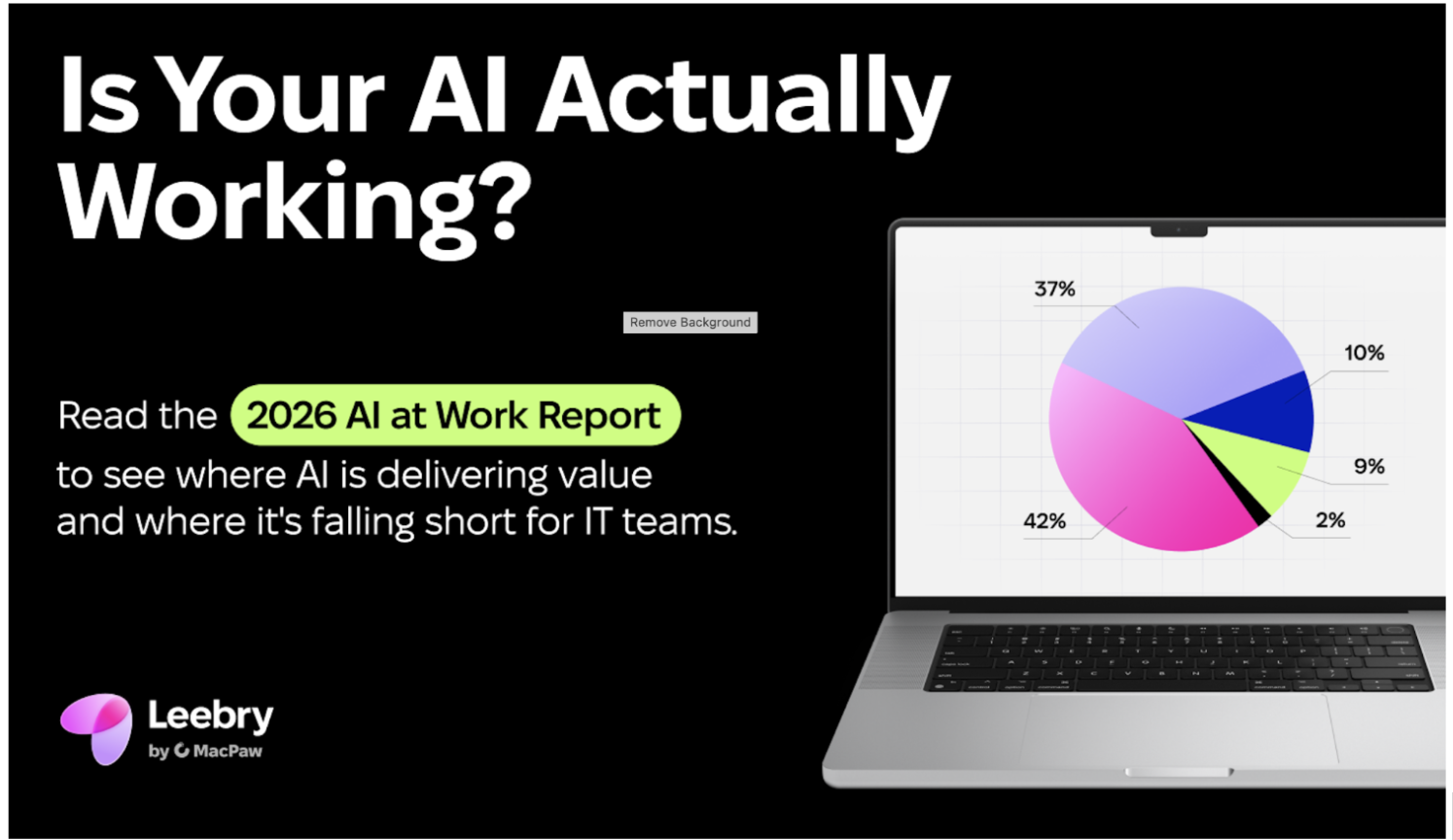
Leebry's new report, AI at Work 2026, is built on responses from 100 IT directors and above. The most consistent finding: the technology is rarely what's failing. 90% of organizations deployed AI without auditing the documentation underneath it, 73% have no formal way to measure outcomes, and 61% of IT leaders are quietly absorbing a gap between leadership expectations and what their team can deliver. Read the full report |
|
|
|
Other
news & articles you might like
-
Fable gets another bump
LINK
-
Waze rolls out new customization features and more Gemini updates
LINK
-
EU regulations could force an Apple Pencil upgrade in early 2027
LINK
-
TSMC, the world's largest contract chipmaker, reports 68% surge in June revenue
LINK
-
Microsoft CEO Satya Nadella issues dire warning: Do not give AI firms your secrets!
LINK
-
Anthropic’s newest enterprise partner is training 20,000 people on Claude — here’s the shift it signals
LINK
-
Europe takes step toward social media ban for kids
LINK
-
Monzo co-founder Tom Blomfield takes leave from Y Combinator to join Anthropic
LINK
-
Ripple CEO says SEC suit nearly pushed company to shut down
LINK
-
How China is ripping off cutting-edge AI from Anthropic, OpenAI — and threatening US national security
LINK
-
FCC approves orbital space mirrors, first test satellites will launch this year
LINK
-
Filing: College app Fizz accuses VC of sharing confidential startup information with rival Sidechat
LINK
-
From Prompt Engineering to Intent Engineering
LINK
-
Ukrainians are using VPNs to cause havoc in Russia by changing fuel station statuses on maps in a bid to cause chaos and confusion
LINK
-
Steam now has 50% more users than PlayStation, and Sony's own decisions might be pushing more players there
LINK
-
OpenAI hardware timeline reportedly unchanged after Apple trade secret theft lawsuit
LINK
|
|
🧰 Trending tools
|
AgentKey: connects AI agents to live external data sources—search, finance, social, crypto—via single MCP plugin install, no custom integrations needed.
LINK
|
|
Osaurus: a native macOS app that runs AI agents locally with persistent memory, autonomous execution, and cryptographic identity, fully offline and open source.
LINK
|
|
Fudge MCP: lets AI coding agents search 10,000 real websites by fonts, colors, and layouts to reference actual design patterns instead of generic guesses.
LINK
|
|
Knockoff: a browser extension that removes fake trademark-squatting brands from Amazon search results, helping you find legitimate, established products faster.
LINK
|
|
You can check the previous tools here, or add your tool here
|
|
📚 Trending papers & reports
|
> Reach 600,000+ tech professionals: If your company is interested in reaching an audience of tech executives, decision-makers and engineers, you may want to advertise with us.
|
|
> Quantum communication limits have been formally verified by a new software library, giving researchers a reliable, reusable foundation for proving what quantum computers and networks can and cannot do.
LINK
|
|
> Health chatbot use depends more on whether people see personal benefits and risks than on the topic discussed, a study of 1,388 Dutch participants finds.
LINK
|
|
> Telecom fraud detection gets a new framework combining traditional machine learning, federated learning, and a fine-tuned language model with blockchain recordkeeping, but the cheaper traditional approach still performs best overall.
LINK
|
|
> Policy ratings from chatbots are skewed by who backs a policy, with most major models scoring China and Russia endorsed proposals lower than identical ones backed by the US or EU.
LINK
|
|
> Decision-making agents can now be tuned to avoid risky outcomes, not just chase the best average result, across a wide range of real-world planning tasks.
LINK
|
|
|
|
|
Techpresso's AI Academy has 330+ step-by-step tutorials on ChatGPT, Claude, Perplexity, and every tool that matters. No fluff — just practical workflows you can use at work. Try it free for 7 days.
|
|
| Did you know? The Apollo Guidance Computer that helped land humans on the Moon had less processing power than a modern pocket calculator. | |
|
💬 How did you find today's edition?
We read every reply — just reply to this email and let us know how we can improve!
|
|
|